Stress and the cell
In this page we compute the stress tensor and the equation of state, we relax the cell at an applied pressure, and we compute the elastic constants.
The stress tensor
We deform the cell with a small strain \(\epsilon\), so each lattice vector becomes \(\mathbf a_i \to (1 + \epsilon)\,\mathbf a_i\). The stress is the derivative of the energy with respect to the strain, per volume:
As for the forces, the wavefunctions stay fixed, because the energy is
stationary in them, and we take this derivative with automatic differentiation.
A positive pressure means that the crystal wants to expand. The stress tells us
whether the lattice constant is at its equilibrium, and it is what a diamond
anvil cell or a strained substrate puts on the crystal. We compute it with
calc.get_stress():
from defuqumat import Calculator

calc = Calculator.from_file("docs/figures/stress_eos/si-eos.in",
                            pseudo_dir="tests/data/pseudo")
stress = calc.get_stress()
print(stress.kbar.diagonal().round(3))    # xx, yy, zz in kbar
print(f"pressure {stress.pressure_kbar:.2f} kbar")
[7.369 7.369 7.369]
pressure 7.37 kbar
stress.kbar is the tensor in kbar, and stress.tensor the same in
Ry/bohr\(^3\). The cubic symmetry makes the tensor diagonal with three equal
entries, and the three printed entries are indeed equal. calc.get_stress(terms=True).terms gives
the kinetic, Hartree, local, nonlocal, exchange-correlation and Ewald parts. If
the input has tstress = .true., the SCF already computes the stress and
get_stress() returns it.
The equation of state
We now get the pressure in a second way. The pressure is also \(P = -dE/dV\), a derivative along a series of separate SCF runs at different volumes. This curve \(E(V)\) is the equation of state. Its minimum is the equilibrium volume, and its curvature gives the bulk modulus, \(B = V\,d^2E/dV^2\).
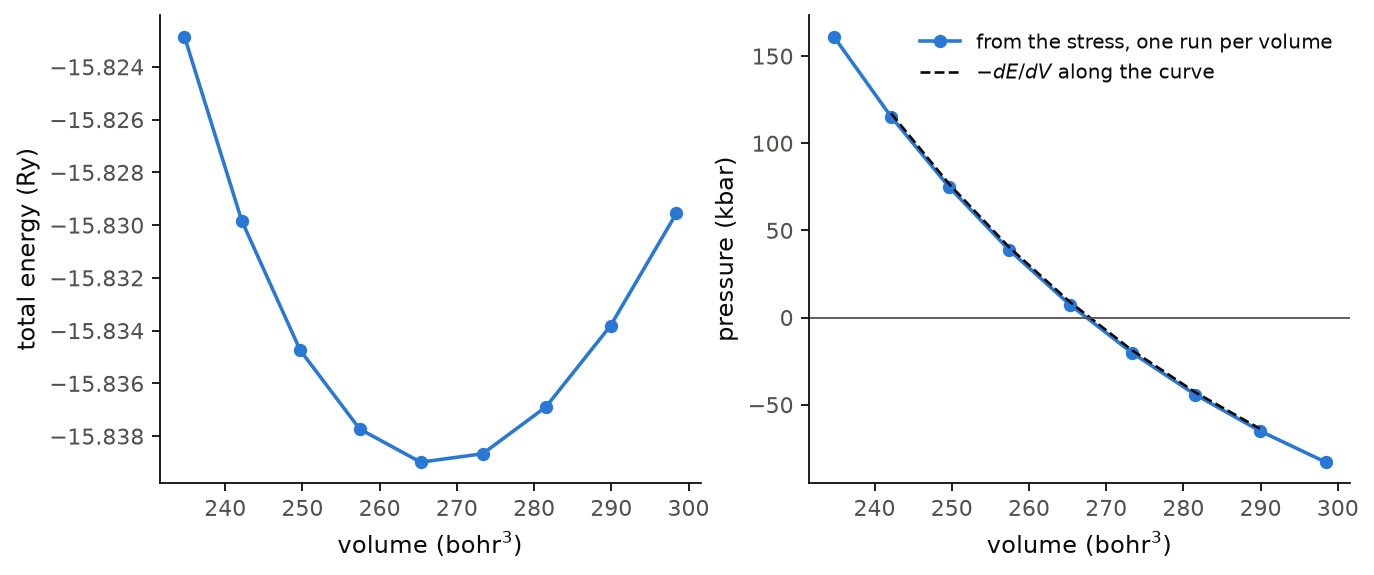
The left panel is the total energy of silicon against the volume, at 40 Ry, for nine lattice constants from 0.96 to 1.04 times 10.20 bohr. The right panel shows the pressure in two ways. The line with points is the pressure from the stress, one SCF per volume. The dashed line is \(-dE/dV\) along the curve on the left, which uses central differences, so it has no value at the two end points. On the seven inner volumes the two agree to 1.9 kbar or better, on a pressure from \(-83\) to 161 kbar. The difference comes from the finite difference along the curve and from the Pulay stress, below. The pressure is zero at 267.5 bohr\(^3\), a lattice constant of 10.23 bohr, which is the equilibrium of silicon in LDA with this pseudopotential. The measured lattice constant is 10.26 bohr.
The Pulay stress is an error of the basis. At a fixed ecutwfc, a larger cell
holds more plane waves, so the energy also falls because the basis gets better.
On this cell it is about 44 kbar at 12 Ry, 1.1 kbar at 40 Ry and 0.11 kbar at
60 Ry. So you should converge the cutoff on the stress, not only on the energy,
before you trust a lattice constant.
Code of this figure (docs/figures/stress_eos/)
"""The equation of state of silicon, and the pressure computed in two ways."""
import numpy as np
from defuqumat import Calculator
from common import PSEUDO, save

calc = Calculator.from_file("si-eos.in", pseudo_dir=PSEUDO)
at = np.asarray(calc.system.cell.at)

volume, energy, pressure = [], [], []
for scale in np.linspace(0.96, 1.04, 9):          # the lattice constant, scaled
    strained = calc.with_cell(at * scale)
    volume.append(float(strained.system.cell.volume))
    energy.append(strained.get_scf().total_energy)
    pressure.append(strained.get_stress().pressure_kbar)
    print(f"V = {volume[-1]:7.2f} bohr^3   E = {energy[-1]:.8f} Ry   "
          f"P = {pressure[-1]:8.2f} kbar", flush=True)

save(volume=np.array(volume), energy=np.array(energy), pressure=np.array(pressure))
"""E(V) of silicon, and the pressure from the stress and from -dE/dV."""
import numpy as np
import style

d = np.load("data.npz")
v, e = d["volume"], d["energy"]
ry_bohr3_to_kbar = 147105.08


def draw():
    fig, (a, b) = style.figure(2)
    a.plot(v, e, "o-")
    a.set_ylabel("total energy (Ry)")
    b.plot(v, d["pressure"], "o-", label="from the stress, one run per volume")
    slope = np.gradient(e, v)[1:-1]                 # central differences only
    b.plot(v[1:-1], -slope * ry_bohr3_to_kbar, **style.reference(),
           label=r"$-dE/dV$ along the curve")
    style.zero_line(b)
    b.set_ylabel("pressure (kbar)")
    b.legend()
    for ax in (a, b):
        ax.set_xlabel(r"volume (bohr$^3$)")
    return fig


style.main(draw)
Relaxing the cell at a pressure
Let us now relax the cell. get_relax(variable_cell=True) is the vc-relax of
pw.x, which moves the atoms and the lattice vectors together and minimizes the
enthalpy
\(P\) is the applied pressure, press in the &cell namelist, in kbar. At the
minimum of \(H\) the stress is \(\sigma = P\,\mathbf 1\), so a relaxed crystal
carries the applied pressure and not zero stress. Here we relax the eight-atom
cubic cell of silicon at 100 kbar:
cell = Calculator.from_file("docs/figures/stress_eos/si8-pressure.in",
                            pseudo_dir="tests/data/pseudo")
result = cell.get_relax(variable_cell=True)

print(f"{result.nsteps} steps")
print(f"volume {result.steps[0].volume:.2f} -> {result.volume:.2f} bohr^3")
print(f"enthalpy {result.enthalpy:.8f} Ry")
print(f"Pulay error {result.pulay_error:.1e} Ry")
4 steps
volume 1061.21 -> 972.47 bohr^3
enthalpy -62.71117414 Ry
Pulay error 2.4e-03 Ry
We see that the volume falls by 8%. The relaxation runs in the plane-wave basis
of the first cell, and at the end the code runs one more SCF in the basis of the
relaxed cell. The energy difference between the two is result.pulay_error, the
error of the fixed basis, and if it is large, the relaxed volume is not
converged in the cutoff. result.cell holds the relaxed lattice vectors in
bohr, and result.stress the stress at the end. cell_dofree in &cell
chooses which parts of the cell can move, as in pw.x.
Elastic constants
Finally we compute the elastic constants, the second derivative of the energy with respect to the strain:
They give the speed of sound, which ultrasound and Brillouin scattering measure.
We compute them from the linear response of the wavefunctions to a strain, in
one calculation and with no strained cells, with
silicon.get_elastic_constants():
silicon = Calculator.from_file("docs/figures/stress_eos/si-elastic.in",
                               pseudo_dir="tests/data/pseudo")
c = silicon.get_elastic_constants()
C = c.voigt                                # 6 x 6, Voigt notation, GPa
print(f"C11 = {C[0, 0]:.1f}   C12 = {C[0, 1]:.1f}   C44 = {C[3, 3]:.1f} GPa")
print(f"bulk modulus {c.bulk_modulus:.1f} GPa")
C11 = 209.4   C12 = 68.0   C44 = 134.0 GPa
bulk modulus 115.1 GPa
c.voigt is the \(6\times6\) matrix in Voigt notation, in GPa, and c.tensor the
full tensor in Ry/bohr\(^3\). The measured values of silicon are \(C_{11} = 165.7\),
\(C_{12} = 63.9\) and \(C_{44} = 79.6\) GPa, and two things make the numbers here
larger. First, this cell has a 12 Ry cutoff and a \(2\times2\times2\) mesh, which
is far from converged. Second, the elastic constants here are clamped-ion,
meaning that the atoms keep their crystal coordinates inside the strained cell.
In the diamond structure this is the full answer for \(C_{11}\) and \(C_{12}\), by
symmetry, but for \(C_{44}\) it is not. A shear strain moves the two atoms of the
cell against each other, and this internal relaxation lowers \(C_{44}\).
Limits
The elastic constants need a norm-conserving dataset. An ultrasoft or PAW
dataset gives an error, because two terms of the derivative for an
augmented dataset are still missing. They also need nspin = 1, an insulator and the
full k-mesh (nosym), so a spin-polarized, noncollinear or spin-orbit run,
a metal and a symmetry-reduced k-set each give an error. The full k-mesh
must also be an unshifted Monkhorst-Pack grid. A shifted grid with nosym
gives an error, because a shifted grid does not have the symmetry of the
crystal. They are clamped-ion only. The page about piezoelectric and strain responses has the
other strain responses, which also work for ultrasoft and PAW.
A strain response that did not converge gives an error, because a diverged
response gives an elastic tensor that is not even symmetric under
\(C_{ijkl} = C_{klij}\). This happens mainly on a slab with vacuum, where the
response diverges at alpha_mix = 0.7. If you set mixing_mode='linear',
first try the default Anderson mixer. Otherwise use a larger
max_iterations or a smaller alpha_mix, which you pass to
get_strain_response(). allow_unconverged=True in
get_elastic_constants() turns the error off for a diagnostic run.
A potential-only meta-GGA (tb09, bj06) has no stress. Its total energy
is not the minimum of any functional, so its derivative has no meaning.
An electric field (tefield or lelfield) gives no stress, and so no
vc-relax, as in pw.x.
The notebooks for this page are 15, the stress tensor, 23, variable-cell relaxation and 21, electrostriction and the elastic constants.