defuqumat
defuqumat is a plane-wave density-functional theory code in Python, and we run
it with a normal Quantum ESPRESSO pw.x input file. With it we compute the
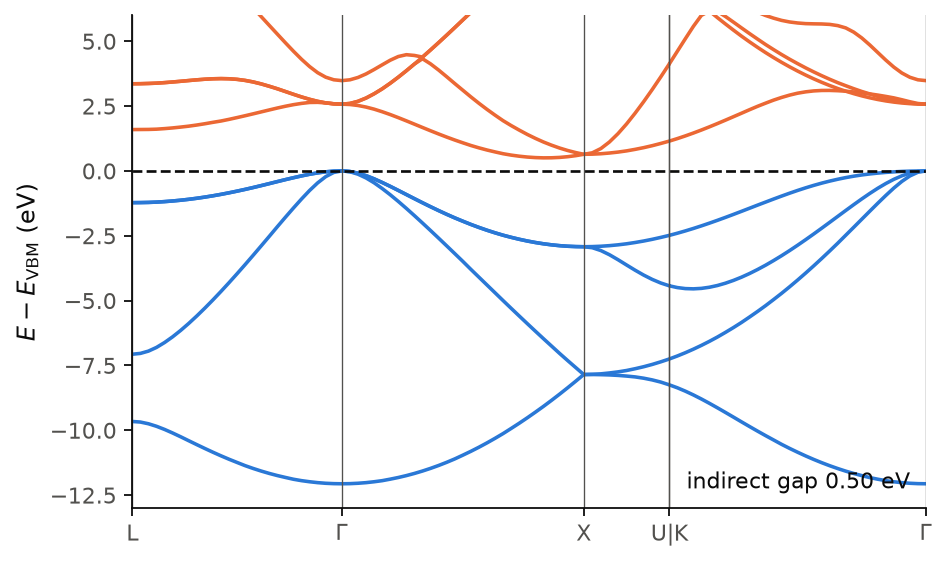
ground state, the band structure and the density of states, and from there
forces, stress, magnetism, linear and nonlinear response, topological invariants
and tunnelling images. In this guide we take one quantity at a time, and for
each we give the equation, what the quantity means, and the few lines of Python
that compute it on a real crystal.
Installing
git clone https://github.com/joselado/defuqumat
cd defuqumat
pip install -e ".[notebooks]"
You need Python 3.10 or newer, and pip installs JAX, NumPy, SciPy, Numba and
equinox. The [notebooks] part adds matplotlib and Jupyter, which you need for
the plots. We run every example in this guide from the root of the repository.
A first calculation
We start with silicon in the diamond structure, with LDA:
from defuqumat import Calculator

calc = Calculator.from_file("docs/figures/bands_silicon/si.in",
                            pseudo_dir="tests/data/pseudo")
scf = calc.get_scf()

print(f"converged in {scf.iterations} iterations")
print(f"total energy {scf.total_energy:.8f} Ry")
converged in 7 iterations
total energy -15.83929992 Ry
The file si.in is a normal pw.x input file. We read it with
Calculator.from_file, and pseudo_dir says where the pseudopotential files
are. The object calc is the crystal together with its pseudopotentials, and
every quantity in this guide is a method of this object, with a name that starts
with get_. If there is no self-consistent ground state yet, the method computes
it first, so this is also a valid script:
calc = Calculator.from_file("docs/figures/bands_silicon/si.in",
                            pseudo_dir="tests/data/pseudo")
dos = calc.get_dos(grid=(12, 12, 12))   # runs the SCF, then the DOS
If you have the text of an input file and not a file, you can use
Calculator.from_text(text, pseudo_dir=...), which works in the same way.
How this guide is organized
- Getting started is how we compute a crystal of your own: the input file, the pseudopotentials, and the two convergence tests you always need.
- Ground state is the total energy and the density, the band structure, and the density of states.
Every page follows the same order. We first give the equation, then what it means and which experiment measures it, then the code, then a figure, and at the end the limits of the code. The code under each figure is the code that made the figure. In the plots we use moderate meshes, so that each figure computes in a few minutes.
Accuracy, and where to find more
When Quantum ESPRESSO or Elk compute the same number, we compared the two codes
on the same input, and the table with these comparisons is in the
README. The
notebooks show
each feature on a real crystal, with more detail than this guide, and the file
notebooks/README.md
lists them by the property you want to compute.