Forces and relaxation
In this page we compute the forces on the atoms, we relax a structure to its minimum, and we add the van der Waals attraction that a semilocal functional does not have.
The force on an atom
The force on atom \(I\) is minus the derivative of the total energy with respect to its position:
The wavefunctions stay fixed in the derivative, and we are allowed to do this because the converged energy is stationary in the wavefunctions. This is the Hellmann-Feynman theorem. We take this derivative of the total energy with automatic differentiation, so the terms from the basis that moves with the atoms, and from the augmentation charge of an ultrasoft or PAW dataset, come out of the same derivative. A force says where the atoms want to go, and a relaxation follows it to the equilibrium structure, which diffraction measures. The derivatives of the forces are the force constants, which give the phonons.
An atom on a high-symmetry site has zero force, so for an example we move the
second atom of silicon by 0.02 alat along \(x\). We compute the forces with
calc.get_forces():
from defuqumat import Calculator

calc = Calculator.from_file("docs/figures/forces_relaxation/si-displaced.in",
                            pseudo_dir="tests/data/pseudo")
forces = calc.get_forces()
print(forces.forces.round(6))      # (atoms, 3), Ry/bohr
[[ 0.060397 -0.        0.      ]
 [-0.060397  0.       -0.      ]]
There was no ground state yet, so the code ran the SCF first and said so on
stderr, because a force is a derivative at the ground state. We see that the two
forces are equal and opposite, and nothing in the code imposes this. The total
force on a crystal is zero, because a rigid translation does not change the
energy. The force on the second atom points along \(-x\), back towards its site.
The forces are in Ry/bohr, as in pw.x.
A noncollinear or spin-orbit run has forces too, with the same call. The energy is then written for two-component spinors, so the nonlocal term takes a \(2\times2\) matrix in spin space and nothing else in the derivative changes.
Relaxing the structure
We now let the atoms move. get_relax() moves them downhill with the BFGS method
until the largest force is below forc_conv_thr and the energy change is below
etot_conv_thr. These are the keywords of the &control namelist, \(10^{-3}\)
Ry/bohr and \(10^{-4}\) Ry if you do not give them, and you can also pass them as
keywords. The symmetry of the crystal is found at the start and kept during the
relaxation.
relax = calc.get_relax()

for step in relax.steps:
    print(f"step {step.index}   E = {step.total_energy:.8f} Ry   "
          f"largest force {step.max_force:.6f} Ry/bohr")
r = relax.positions
print((r[1] - r[0]) / calc.system.cell.alat)    # the bond, in alat
step 1   E = -15.78740371 Ry   largest force 0.060397 Ry/bohr
step 2   E = -15.79256152 Ry   largest force 0.024848 Ry/bohr
step 3   E = -15.79359588 Ry   largest force 0.000369 Ry/bohr
step 4   E = -15.79359610 Ry   largest force 0.000002 Ry/bohr
[0.25000073 0.25       0.25      ]
The bond is back at \((1/4, 1/4, 1/4)\), the diamond structure. Both atoms moved,
by half of the displacement each, because the forces on them are equal and
opposite. relax.steps holds the positions, the energy and the largest force of
each step, and relax.converged says whether the thresholds were reached.
calc.relaxed() returns a new calculator at the relaxed structure, with its SCF,
so you can go on with any other get_* method there. If you want to fix an atom,
set its if_pos flags to 0 in ATOMIC_POSITIONS, as in pw.x.
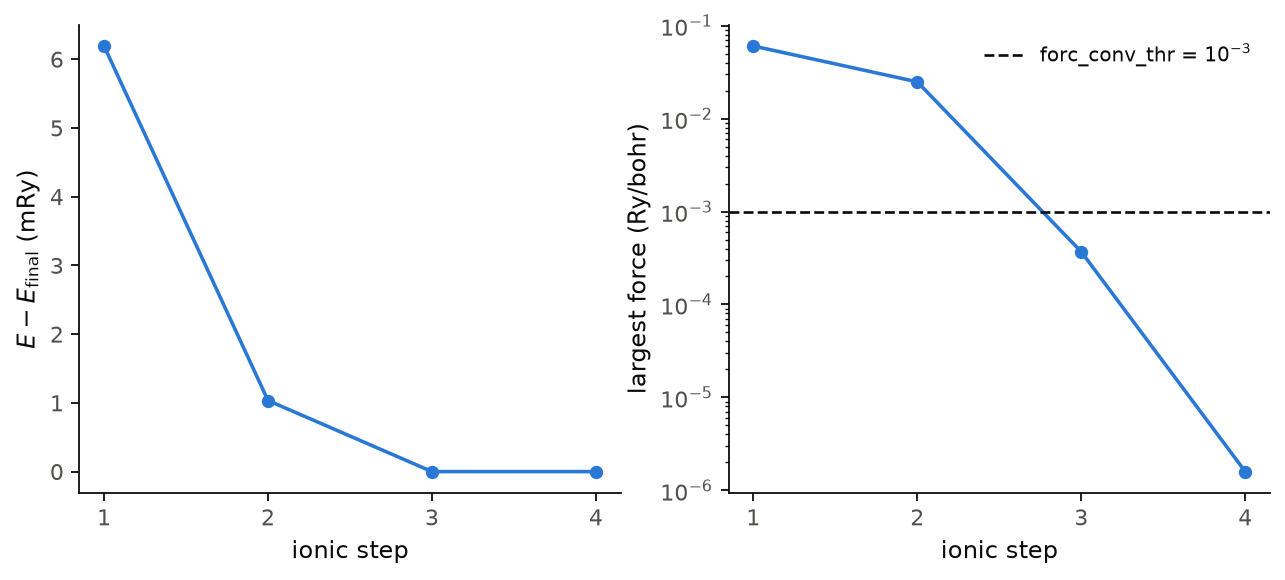
The left panel shows the energy at each step, and the right panel the largest
force. The energy falls by 6.2 mRy, and the force falls from 0.06 to
\(2\times10^{-6}\) Ry/bohr in four steps. At step 3 the force is already below
forc_conv_thr, but the energy changed by 1 mRy from step 2, which is more than
etot_conv_thr. Step 4 changes the energy by \(2\times10^{-7}\) Ry, so both
criteria hold and the relaxation stops. Near a minimum the energy is flat while
the force is still linear in the distance, so the force is the more sensitive
measure of how close the structure is to the minimum.
Code of this figure (docs/figures/forces_relaxation/)
"""Silicon relaxing back to its lattice sites: energy and force at each step."""
import numpy as np
from defuqumat import Calculator
from common import PSEUDO, save

calc = Calculator.from_file("si-displaced.in", pseudo_dir=PSEUDO)
relax = calc.get_relax()

alat = calc.system.cell.alat
steps = relax.steps
save(step=np.array([s.index for s in steps]),
     energy=np.array([s.total_energy for s in steps]),
     max_force=np.array([s.max_force for s in steps]),
     x=np.array([(s.positions[1, 0] - s.positions[0, 0]) / alat for s in steps]))
"""The energy and the largest force at each step of the relaxation."""
import numpy as np
import style

d = np.load("data.npz")


def draw():
    fig, (a, b) = style.figure(2)
    a.plot(d["step"], (d["energy"] - d["energy"][-1]) * 1e3, "o-")
    a.set_ylabel(r"$E - E_{\rm final}$ (mRy)")
    b.semilogy(d["step"], d["max_force"], "o-")
    b.axhline(1e-3, **style.reference(), label="forc_conv_thr = $10^{-3}$")
    b.set_ylabel("largest force (Ry/bohr)")
    b.legend()
    for ax in (a, b):
        ax.set_xlabel("ionic step")
        ax.set_xticks(d["step"])
    return fig


style.main(draw)
Van der Waals: the D2 correction of Grimme
Let us now add the van der Waals attraction. LDA and GGA see only the density where it is, while the van der Waals attraction comes from correlated charge fluctuations on two atoms whose densities do not overlap, so a semilocal functional misses it. Layered crystals, molecular crystals and molecules on surfaces are held together by it. The D2 correction of Grimme adds it as a pair sum over the atoms:
Here \(C_6^{ij} = \sqrt{C_6^i C_6^j}\) comes from a table of atomic values, and
\(\mathbf L\) runs over the lattice. The damping function switches the \(R^{-6}\)
tail off at short distance, where the functional already describes the
interaction. You switch it on with vdw_corr = 'grimme-d2' in &system, and
london_s6 and london_rcut set \(s_6\) and the cutoff of the sum, as in pw.x.
Here we take bilayer graphene:
bilayer = Calculator.from_file("docs/figures/forces_vdw/bilayer.in",
                               pseudo_dir="tests/data/pseudo")
scf = bilayer.get_scf()
print(f"total energy {scf.total_energy:.8f} Ry")
print(f"D2 energy    {scf.energy_terms['dispersion']:.8f} Ry")
total energy -45.10439956 Ry
D2 energy    -0.02305929 Ry
The D2 energy depends only on the positions of the atoms and on the cell, so it does not change the density, the bands or the potential. The run with D2 has the same density as the run without it, and the two total energies differ by exactly \(E_{\rm disp}\). The correction enters the forces, the stress and so the relaxations, and the elastic constants.
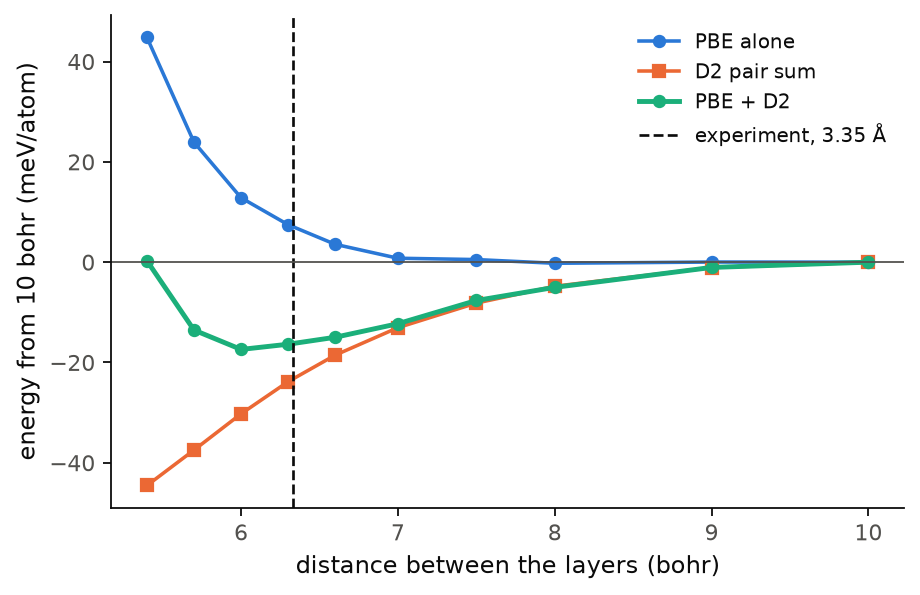
The figure shows the energy of bilayer graphene against the distance between the two layers, measured from its value at 10 bohr. PBE alone is repulsive below 8 bohr, and beyond 8 bohr it is flat to 0.3 meV per atom, so PBE does not bind the layers. The D2 pair sum is attractive at every distance and has no minimum by itself. Their sum has a minimum at 6.09 bohr (3.22 Å), from a parabola through the three lowest points, with a depth of 17.6 meV per atom, and the measured distance in graphite is 3.35 Å. The depth is a lower bound, because the cell is 20 bohr tall. At 10 bohr each layer is as close to the periodic image of the other layer as to the other layer itself, so the energy at 10 bohr still has some binding in it.
Code of this figure (docs/figures/forces_vdw/)
"""The binding curve of bilayer graphene, with and without the D2 correction."""
import numpy as np
from defuqumat import Calculator
from common import PSEUDO, save

calc = Calculator.from_file("bilayer.in", pseudo_dir=PSEUDO)
height = float(calc.system.cell.at[2, 2])          # bohr
positions = np.array(calc.system.structure.positions)

separations = np.array([5.4, 5.7, 6.0, 6.3, 6.6, 7.0, 7.5, 8.0, 9.0, 10.0])   # bohr
total, dispersion = [], []
for d in separations:
    positions[:2, 2] = (height - d) / 2             # the lower layer
    positions[2:, 2] = (height + d) / 2             # the upper layer
    scf = calc.with_positions(positions).get_scf()
    total.append(scf.total_energy)
    dispersion.append(scf.energy_terms["dispersion"])
    print(f"d = {d:5.2f} bohr   E = {total[-1]:.8f} Ry   E_disp = {dispersion[-1]:.8f} Ry",
          flush=True)

# D2 does not change the density, so PBE alone is the total minus the pair sum
save(separation=separations, total=np.array(total), dispersion=np.array(dispersion))
"""PBE alone, the D2 pair sum, and their sum, against the interlayer distance."""
import numpy as np
import style

d = np.load("data.npz")
x = d["separation"]
mev = lambda e: (e - e[-1]) * 13605.693 / 4       # meV per atom, from 10 bohr


def draw():
    fig, ax = style.figure()
    ax.plot(x, mev(d["total"] - d["dispersion"]), "o-", label="PBE alone")
    ax.plot(x, mev(d["dispersion"]), "s-", label="D2 pair sum")
    ax.plot(x, mev(d["total"]), "o-", lw=2.2, label="PBE + D2")
    ax.axvline(3.35 / 0.529177, **style.reference(), label="experiment, 3.35 Å")
    style.zero_line(ax)
    ax.set_xlabel("distance between the layers (bohr)")
    ax.set_ylabel("energy from 10 bohr (meV/atom)")
    ax.legend()
    return fig


style.main(draw)
Limits
get_forces(method="analytic") computes the force from the expressions of
pw.x, term by term, as a check. It gives an error for a noncollinear or
spin-orbit run, because these expressions have no spinor form, and the
default method works there. The same holds for a relaxation with
force_method="analytic". The stress has no analytic method at all, and
get_stress(method="analytic") gives an error on every run, collinear or
not, because the nonlocal part of the stress is not written out term by
term. The default method gives the whole stress, spinors included.
get_forces(method="analytic") also gives an error for an ultrasoft or PAW
cell whose table of the augmentation charge would be larger than 2 GiB,
because the code then keeps only a radial table and builds the charge a piece
at a time, while the analytic force needs the whole table. The environment
variable DEFUQUMAT_AUG_MAX_BYTES moves the 2 GiB limit. The default method
works on such a cell and gives the same force.
get_forces() works for a norm-conserving spin spiral, where each spinor
component meets the projectors of its own sphere. We checked it against the
four-cell supercell of the NiI chain, to 1e-8 Ry/bohr. It gives an error for
an ultrasoft or PAW spiral and for a spiral with DFT+U, which have no check.
get_relax() on a spiral has not been run. get_stress() works for a
norm-conserving spiral. A strain keeps spiral_q fixed in units of the
reciprocal lattice vectors, as it keeps the k-points, which is the strain of
the supercell. It gives an error for an ultrasoft or PAW spiral and with
DFT+U. What we compute for a spiral instead is the derivative of the energy
with respect to its wavevector, on the page about spin spirals.
A noncollinear or spin-orbit run has forces, a stress and a relaxation, but the elastic constants and the electrostriction give an error, because they take a third derivative and none has been checked with spinors.
A potential-only meta-GGA (tb09, bj06) has no energy functional, so it
has no forces and no relaxation.
We implement only D2, and D3, Tkatchenko-Scheffler, MBD and XDM give an
error. pw.x runs them with a warning and no correction at all.
The notebooks for this page are 09, forces and relaxation and 22, van der Waals.